There’s a saying in product development that goes, “When you’re 90% done, you have 90% left to do. Well, we’re definitely at that stage, doing the fine tuning of the experience of gameplay, especially the game learning (teaching) portion.
- Player Onboarding
- Unguided Testing
- Product and Art Development
Player Onboarding
That is, how to ease players into the kinds of discussion and displays they’re asked to get into without personally being there to set an example? The solution we’ve come up with is one that mirrors a lot of other card-based storytelling games; the most well-known version is the opening sequence of play in For the Queen. This introductory mechanic has people read a pre-defined series of cards in order to learn the gameplay, the rules, and the safety techniques. In our game, we are planning to write some example lurid descriptions of a new introductory card we want to design that gives everyone their own example to read and not have to come up with themselves before they even know what’s going on.
Add to the to-do list…
- Prototype one introductory sample card (tentatively: “Birds & Bees”)
- Write some number of new cards, culminating with written descriptions of the sample card
- Add all of this to prototype decks
- Start testing this mechanism
Unguided Testing
We’ve done a lot of in-person testing where we guide the process and set examples, but we haven’t really tested the rule book itself for how well it communicates the gameplay, how easy it is to comprehend and teach, and what mistakes might be made in the process.
More to-dos…
- Get the rule book into working order, in a format that mostly resembles a “finished” product
- Test with experienced game designers to read and give feedback, just on the rules/components
- Edit as needed
- Test with miscellaneous gamers to read and teach the game, observe silently and note mistakes and consider how to clarify the writing in the rule book
- Edit as needed
- Test again
Product and Art Development
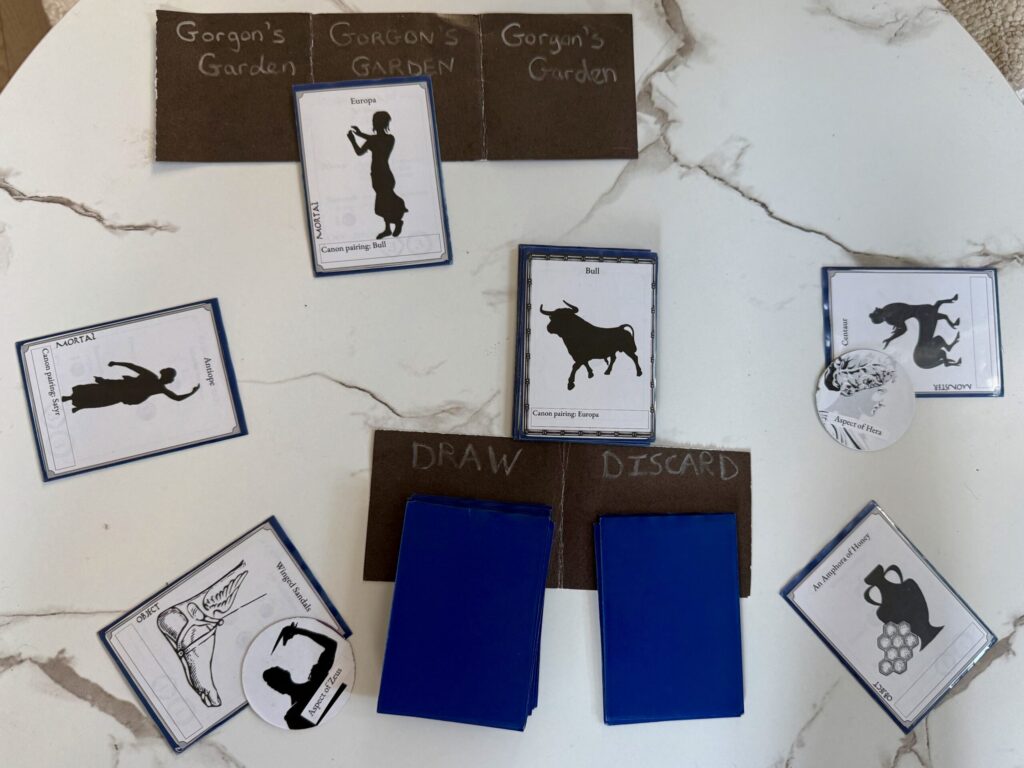
We have so far been testing a prototype that uses poker-sized cards (2.5″ x 3.5″), but haven’t really played any games with the tarot-sized cards (2.75″ x 4.75″) that we want to use for our finished product. Here’s a more in-depth explainer on some of the differences. This kind of usability testing can have a big effect on what our final designs end up looking like, considering how people hold the cards and what information is visible. I’ve finally found some tarot-sized plastic card sleeves that we can put a printed prototype into, and work on testing the accessibility and usability of those, as well as starting to move towards a finished design language for the game.
Even more to do…
- Draft a tarot-sized graphic design for the cards
- Print it out and sleeve it so we have some realistic things to experiment with
- Revise, refine, re-do, etc.
- Test it with people who game
Takeaways
Progress in any creative work made to share isn’t linear. The excitement of creativity usually needs rounds of iteration to make sure it’s satisfying all the things you want it to do. We’re feeling pretty good that we can see the finish line at which point we get to share it widely. We hope you’ll join us for that celebration!